


By looking at site 1, 2, and 3 each student is applying one of the five typeforms (temple, monument, theater, market, pavilion) to each of the site conditions. (Images and text by Jungmin Yoo)

By looking at site 1, 2, and 3 each student is applying one of the five typeforms (temple, monument, theater, market, pavilion) to each of the site conditions. (Images and text by Jungmin Yoo)


Pull back away, disperse into the atmosphere, accelerate another space, and see more volumes. Each and every one of you has work that goes beyond the Genesee Towers. Each strategy is ripe for another site, and each site capable of testing and morphing a strategy. Discover its deployments. Anticipate. Observe. Agitate. Take nothing lightly.
Projecting into another design project, first evaluate your instincts in Flint. Our endeavors and tendencies run deep into the way we see and express the world. Mine the existing initiatives, search for what pulls you, and throw out what you have only been
dragging along. (Images 1 and 2 by Maja Mrdalj, image 3 by Heather Losley, and text by Catie Newell)


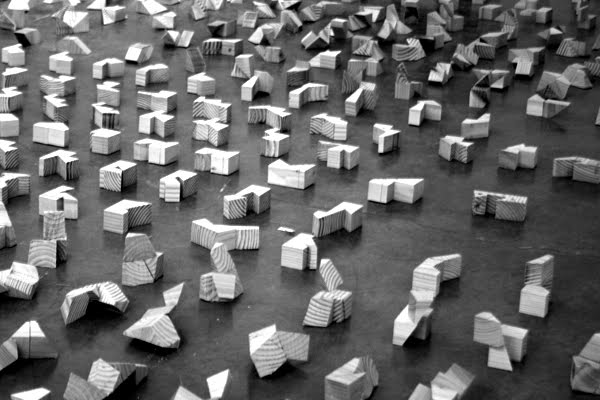
 Steven Mankouche’s studio, An Amish Riddle, is working on the manual mass production of algorithmic derivations. Two or three cuts were made to a scaled 20' x 20' x 40' block, and rules defining the re-arrangment of these pieces resulted in combinations varying (student to student) from 250 – 5000+. This is not just a formal exercise; the process of cutting and re-arranging sets up a doctrine—the resulting forms become the new rule set for the next game, a rule set to be exploited, bent, and broken.
Image 01: thousands of uncut blocks, waiting for the band saw. Image 02: manual mass production.
Image 03: our mindset, our glory, and our downfall—cut blocks waiting for assembly. Images 04-08: week 1 pin-up. (Images 01-03 by Ian Sinclair, images 04-08 by Steven Mankouche, text by Ian Sinclair)
Steven Mankouche’s studio, An Amish Riddle, is working on the manual mass production of algorithmic derivations. Two or three cuts were made to a scaled 20' x 20' x 40' block, and rules defining the re-arrangment of these pieces resulted in combinations varying (student to student) from 250 – 5000+. This is not just a formal exercise; the process of cutting and re-arranging sets up a doctrine—the resulting forms become the new rule set for the next game, a rule set to be exploited, bent, and broken.
Image 01: thousands of uncut blocks, waiting for the band saw. Image 02: manual mass production.
Image 03: our mindset, our glory, and our downfall—cut blocks waiting for assembly. Images 04-08: week 1 pin-up. (Images 01-03 by Ian Sinclair, images 04-08 by Steven Mankouche, text by Ian Sinclair)

The extreme density of the contemporary urban condition requires a multitude of infrastructures to handle the movement of both goods and people. Differences in speed and direction force these systems into awkward intersections resulting in spatial divisions. In order to overcome the negative consequences of such events the systems must be carefully overlaid and re-distributed sectionally. Integration of transportation infrastructure provides new opportunities for interaction between the pedestrian, auto, and rail systems. (Diagram and text by Alex Carmichael)


Rosalyne Shieh’s students spent the first week of the semester investigating formal types and typeforms by extracting concepts from five building typologies (temple, monument, theater, pavilion and market). Each type was looked at from three examples in different time periods. Students worked in pairs and each team was responsible for two typeform groups. Each building was analyzed through solid-void models, figure-ground drawings, and line drawings. (Photos of week 1 pin-up and project description by Jungmin Yoo.)


 Examples of work from the first weeks of the No Vacancy Studio. (Images 1 and 3 by Michelle Whitaker, Images 3 and 4 by Simon Rolka)
